
Custom large arched bathroom mirror factory - Bulk Supply and Specification Guide
During a private-label launch with a fixed ship date, an arched bathroom mirror can become a return risk before the first unit leaves the factory: a crown that differs from the approved drawing, visible edge marks, or a glass thickness that feels too flexible at the chosen width. For importers and OEM buyers, agreeing the drawing, sample and inspection points before production is the practical way to keep repeat orders aligned.
Where Cheaper Alternatives Fall Short
At large sizes, small differences in glass flatness, edge finishing and arch geometry show up across the mirror rather than disappearing into the room. A low-cost panel may meet the nominal width and height but still look uneven beside a tiled wall if the crown radius or the transition into the straight sides differs from the approved profile.
Returns also follow moisture-related edge damage. If water repeatedly reaches an exposed mirror edge, corrosion can appear at the silvering; a decorative frame does not correct a poor glass edge or an unsuitable backing. Confirm the intended bathroom conditions, edge treatment and mounting method together, rather than comparing unit price alone.
The lowest quote can also leave the buyer with undocumented substitutions. A change from the sampled glass thickness, backing film or frame finish may alter perceived stiffness, weight or appearance. Keep those items on the approved specification so a reorder does not rely on a verbal description.
Design Constraints Behind the Specification
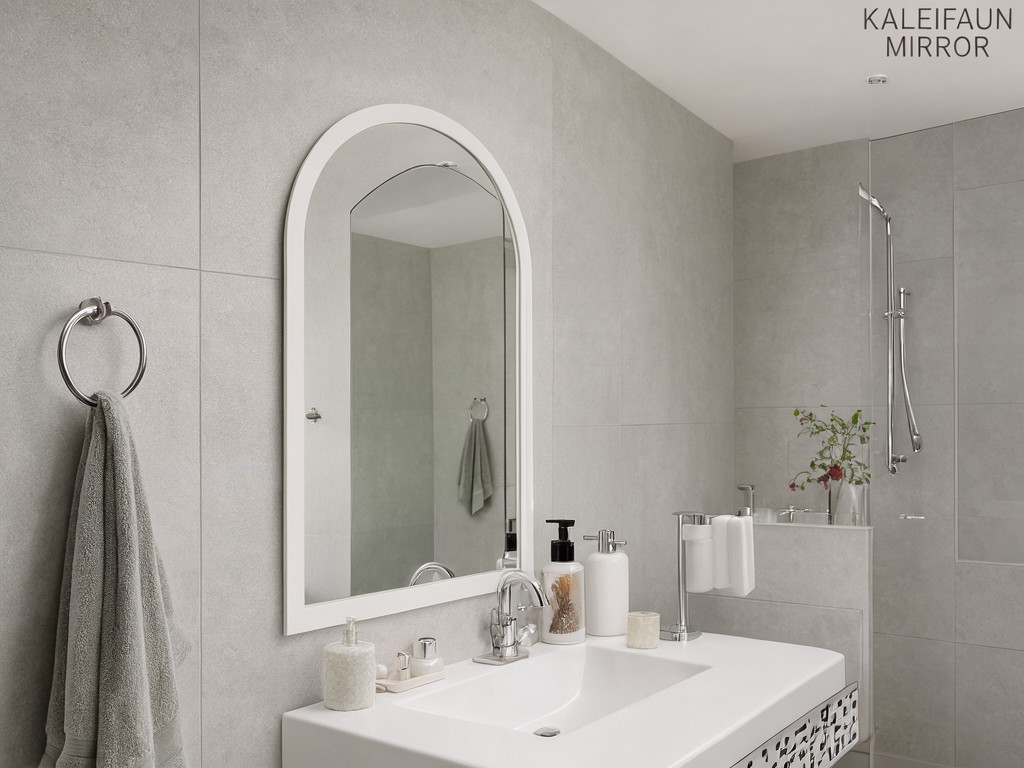
A reliable production drawing defines more than the outside dimensions. It should show overall width and height, the height of the straight sides, the arch profile, glass thickness, edge finish, backing and mounting points. For a non-semicircular crown, provide a dimensioned profile or a full-scale template; “arched top” alone leaves room for visible variation between batches.
The factory can review the drawing, prepare a pre-production sample and record the agreed dimensions and finish before the bulk run. Set tolerances for the outside dimensions and profile during that review. Where the mirror has a frame, approve its visible width, corner or joint details, coating colour and the gap between frame and glass on the physical sample.
Approval rule: release production only against a dated drawing and an identified sample. Record any permitted dimension variation, glass construction, edge treatment and finish code there; otherwise a visually similar substitute may still differ on the wall.
Finish and Colour Options
Finish selection affects both the look of the mirror and the inspection reference for repeat orders. Approve colour against a physical sample under representative lighting, especially for metallic finishes.
| Configuration | Typical appearance | Approval point |
|---|---|---|
| Frameless, polished edge | Uninterrupted glass outline | Edge polish, corner smoothness and backing coverage |
| Black frame | Defined dark border around the arch | Coating shade, frame width and joint appearance |
| Brushed champagne or similar metallic finish | Warm metallic frame detail | Brushed direction, colour sample and surface consistency |
| Custom frame colour | Matched to the buyer’s range | Approved colour reference and acceptable batch variation |
Size, Weight and Specification Range
For many residential vanity layouts, custom orders fall around 450–1,200 mm wide and 900–2,000 mm high, subject to the glass processor’s sheet limits and the design of the arch. Treat these as planning ranges, not fixed production limits. Confirm the final dimensions against the mounting position, faucet clearance and the available wall area.
Bathroom mirrors commonly use 4 mm or 5 mm glass; larger panels may call for 5 mm glass where the buyer prefers a firmer feel, subject to the mounting design and factory review. As a planning estimate, mirror glass weighs about 2.5 kg per square metre per millimetre of thickness, before adding a frame or fittings. A 5 mm panel therefore adds about 2.5 kg per square metre over a 4 mm panel, a trade-off to check against the wall fixing and handling plan.
Specify whether the mirror uses a safety backing film, the required edge finish, and the position and type of hangers. Ask the factory to list measurable inspection points on the approval drawing: overall dimensions, arch profile, visible defects, frame dimensions where applicable and hanger position. The buyer and factory should agree tolerances in writing before sample approval.
Comparing Two Standard Configurations
A frameless 4 mm mirror can reduce material weight and suit a minimal retail range. A framed 5 mm version generally uses more material and adds assembly steps, but its border can protect the visible edge from routine contact. The right choice depends on size, mounting and the price point—not on thickness alone.
- Start with the approved wall layout and target price.
- If weight and a minimal outline lead the decision, review a frameless 4 mm sample; check the edge polish and backing coverage closely.
- If edge protection and a defined border matter more, review a framed 5 mm sample; include frame width and finish in the approved drawing.
- Compare the samples at the intended viewing distance. Confirm reflection appearance, arch shape, edge detail and mounting position before the buyer signs off.
- Freeze the chosen construction and its material list for the order. Any later change to glass thickness, backing, hanger or frame finish requires renewed approval.
Buying Mistakes That Lead to Returns
When a buyer approves only a product photo, the factory has no controlled reference for the arch curve, frame colour or edge finish. Request a dimensioned drawing and sample approval record; keep artwork, logo placement and any label files in the same revision set. Artwork should identify its position and orientation relative to the mirror, not just the overall product.
Another preventable cause is selecting glass thickness without considering mirror size and fixing points. A large panel can feel less rigid than expected, and a hanger position copied from a smaller size may not suit the new format. Have the factory confirm the proposed construction and mounting arrangement for each size, then inspect a production sample against the agreed drawing.
Finally, do not leave “chrome,” “gold” or “black” as the only finish description. Those names do not define shade, sheen or texture. Use a physical reference or approved finish sample and record any acceptable variation before repeat production.
Usage Scenarios and Buyer Segments
When a brand extends an existing range, the mirror has to match the established frame finish and arch proportions across more than one size. A signed sample and drawing revision help the product manager preserve that visual match on later orders.
For importers supplying bathroom retailers, the selection often balances shelf price against the cost of damage claims and customer dissatisfaction. A frameless design may suit a clean, low-profile range; a framed configuration may better match a collection built around visible metal details. Confirm that the approved finish and dimensions align with the retailer’s product listing and the unit being ordered.
On multi-unit residential projects, installers need repeatable hanger positions and consistent outside dimensions across bathrooms. Buyers should provide the wall layout and fixing requirements early, then approve a size-specific drawing where the range includes multiple widths or heights. That small step reduces on-site adjustment and helps keep replacements consistent with the original installation.
Request a Pre-Production Sample
Send the target size, arch drawing or template, glass thickness, edge and backing requirements, mounting details and frame finish reference. We can review the specification and prepare a sample for approval before bulk production. Request a sample and specification review.







