
Specifying Custom Project Supply Arched Bathroom Mirror Company for Wholesale and OEM Orders
Consistency is set at the forming stage, but an arched mirror is generally shaped by cutting and edge-finishing flat glass rather than bending it. For a second-source qualification, buyers should compare the cut profile, edge quality, reflective coating system and backing protection—not just the outline on a drawing.
A controlled sequence typically runs from glass selection and profile cutting through edgework, any specified tempering, reflective coating, backing protection and final inspection. Each hand-off can affect fit and service life: an inconsistent arch radius complicates installation, while exposed or damaged coating at an edge can become a corrosion point in a humid room.
How It Performs in Use
The build method decides how well the mirror tolerates daily wiping, humidity and installation stress. The front glass provides the viewing surface; the silver layer forms the reflection on the rear face, and protective layers limit exposure of that coating to moisture and cleaning residue.
Service-life check: specify sealed, finished edges and a backing system suited to humid interiors. Cleaner trapped at the perimeter or standing water behind the glass can attack the coating from the edge, even when the central reflective area remains intact.
For routine care, a soft cloth and a mild, non-abrasive cleaner place less stress on the face and perimeter. Scouring pads, harsh chemicals and repeated wetting of exposed edges raise the risk of scratches, backing damage or dark spots. Direct sunlight through a window can also warm the assembly and expose backing materials to prolonged UV; confirm the intended placement and coating options before approving the sample.
Materials and Construction Trade-offs
Process choice shows up later as edge condition, coating resistance and landed cost. Glass thickness, safety treatment and backing specification should be chosen together; changing one after the profile and mounting details are approved can affect weight, handling and fit.
Glass and Edgework
Thicker glass adds rigidity and can suit larger formats, but increases unit weight, freight demand and the load on wall fixings. A polished edge costs more than a basic ground edge; it gives a finished perimeter that is easier to inspect and less prone to handling chips.
Reflective Coating and Safety
A copper-free silver mirror system can be specified with protective backing paint for bathroom use. A rear safety film may help retain fragments if breakage occurs, but it does not make the glass unbreakable or replace the buyer’s mounting and handling requirements.
Confirm whether the order requires annealed or tempered glass before the production sample is signed off. Tempering changes the processing sequence and can affect achievable dimensions, edge details and cost; coating and safety requirements should be reviewed as one specification rather than added after tooling approval.
Specification Range and Customisation Limits
Set the installation envelope first, then resolve the profile and material choices. A useful drawing identifies overall width and height, arch radius or profile points, edge finish, glass thickness, mounting method and allowed dimensional variation.
- If the project uses a repeatable standard outline, submit the approved width, height and arch geometry; production can then hold the profile against a master drawing.
- If the outline is project-specific, provide a dimensioned drawing or full-scale template.
- For a simple arch, define the transition from straight sides to the curved crown.
- For an asymmetric profile, identify reference points and the viewing face so the sample is not mirrored incorrectly.
- If safety treatment or rear film is required, confirm it before sample approval; thickness and processing choice affect weight, edge details and final cost.
- If the installation depends on clips, holes or adhesive pads, provide their location and size on the drawing. Late changes can require a revised sample and new inspection criteria.
Indicative project formats commonly fall around 300–1,200 mm wide and 500–2,000 mm high, with glass often specified at 3–6 mm. These are planning ranges, not guaranteed limits; achievable size depends on glass type, profile, processing route, packing method and destination handling.
Requirements by Buyer Segment
Private-label buyers need repeatable appearance across replenishment orders. Keep the approved drawing, coating specification, brand mark placement and packaging artwork under revision control; otherwise a nominally identical reorder can arrive with a different arch or carton presentation.
- OEM buyers should align the mirror drawing with the cabinet, vanity or wall-mount interface, including clearance for clips and installation hardware.
- Wholesale buyers generally compare landed cost, carton count and breakage exposure alongside finish consistency. A lower unit price can lose its value if the pack format raises damage claims or storage handling time.
- For a second-source qualification, compare samples against the same dimensional checkpoints, edge inspection criteria and coating appearance. A shared reference sample makes supplier-to-supplier review more useful than comparing catalogue descriptions.
Working as a Production Partner, Not a Catalogue Supplier
A project supply relationship starts with drawing review and sample approval, not selection from a fixed range. The factory should confirm which dimensions, edge details and coating choices can be held through production, then document any limits before the buyer releases the order.
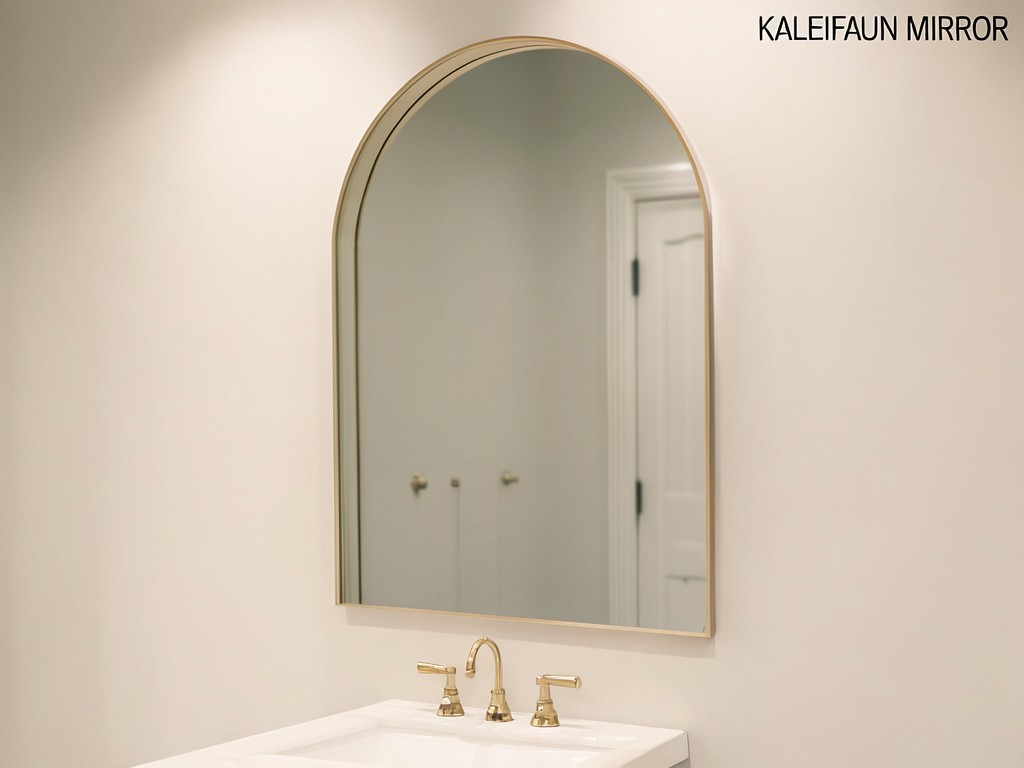
For OEM and ODM work, buyers can provide a dimensioned profile, mounting layout, logo artwork and carton requirements. The supplier can return a manufacturability review, identify high-risk corners or narrow edge sections, and prepare a pre-production sample for written approval. Any change to glass thickness, safety film, backing paint or artwork after approval should trigger a controlled revision.
Second-source checks are most useful when both factories receive the same specification and inspection points. Agree on how to assess overall dimensions, arch symmetry, edge chips, reflective appearance, coating marks and packaging condition; retain batch identification so issues can be traced to the production lot.
Export Packaging and Handling Protection
Arched corners and polished edges need separation from adjacent glass and carton walls. Packaging should limit movement during handling and freight, while keeping the reflective face and rear coating away from abrasive contact.
| Pack Element | Purpose and Buyer Check |
|---|---|
| Face and rear-surface separation | Use a non-abrasive separator to prevent rubbing against the reflective face or backing during vibration and movement. |
| Edge and arch-crown cushioning | Protect the perimeter from direct impact; check that the curved crown cannot shift into the carton wall. |
| Carton or pallet configuration | Confirm pack quantity, orientation, stacking method and external marks against the buyer’s warehouse and freight-handling plan. |
| Retail and traceability labels | Approve SKU, barcode, handling symbols and batch reference before print so cartons support receiving and issue investigation. |
The sample pack should match the intended export configuration as closely as possible. A mirror that passes visual inspection at the factory can still arrive with chipped edges if dividers, corner protection or pallet restraint do not suit its size and weight.
Questions Buyers Ask Before Ordering
Can the arch profile be reproduced from a photograph?
A photograph can guide the design, but it is not a dependable production reference because camera angle and perspective distort the curve. Supply a dimensioned drawing or physical template for approval, especially when the mirror must align with a cabinet or mounting points.
Does a rear safety film prevent breakage?
No. It can help retain fragments after breakage, but it does not prevent impact damage. Buyers should specify the required glass treatment and confirm that the selected mounting system suits the mirror’s dimensions and weight.
How do MOQ and sample cost change with customisation?
A new profile, special edge treatment, unique backing or printed carton can add setup and approval work. MOQ and sample charges depend on those choices and the packing configuration, so request a quotation against the final drawing and artwork rather than a preliminary concept.
What artwork is needed for branded packaging?
Provide vector logo files, required text, barcode data and the intended label or carton layout. Approve a proof that shows the actual print position and pack orientation before production.
Review the Artwork and Branding Before Release
Send the approved mirror drawing, mounting details, brand files and packaging requirements for a project review. Resolve profile, finish and carton questions before the sample is signed off.
Request an artwork and branding review






