
custom asymmetrical curved decorative wall mirror factory - Bulk Supply and Specification Guide
What Actually Determines Performance
Repeat loading drives the failure: each lift, carton shift, and wall installation puts stress through the mirror’s perimeter and mounting points. For most decorative designs described as asymmetrical and curved, the glass remains flat; the outline carries the organic curve. That distinction matters because the buyer is specifying a shaped, flat mirror rather than a formed optical surface.
Glass thickness trades panel weight against handling stiffness and freight cost. A lighter panel can reduce carton weight, while a thicker panel adds mass and can be less prone to flex during handling; neither choice compensates for sharp internal corners, poor edge finishing, or weak mounting hardware. Set the glass thickness, contour radii, and hanging method together against the finished size and installation conditions.
Construction Method and Its Effect on Consistency
A typical production route starts with float mirror glass, followed by template or CNC contour cutting, edge grinding and polishing, cleaning, inspection, and application of the backing or safety film when specified. The reflective coating and protective backing are applied to the rear face of the glass; the visible outline is established by the cutting and edge-finishing stages.
Small changes in the cutting path can alter a distinctive curve from one production lot to the next. A controlled digital outline and an approved first-off sample give repeat orders a fixed reference for the silhouette, mounting positions, and overall dimensions. Avoid abrupt concave transitions: a suitably generous radius is easier to cut and finish consistently than a tight inside corner.
Specification Range and Customisation Limits
Agree the outline drawing and measurement points before quoting a production run. Maximum practical dimensions depend on the glass sheet, contour complexity, edgework, handling equipment, and export carton design; they should be confirmed against the selected factory process rather than assumed from a standard rectangular panel.
| Inspection point | Factory check | Buyer specification to confirm |
|---|---|---|
| Glass thickness | Gauge check at agreed positions | Common options include 3, 4, 5, or 6 mm, subject to size and processing capability. |
| Overall size and contour | Dimensional checks against the approved drawing or sample | Specify measurement points, allowable variation, and the reference edge for irregular profiles. |
| Edge finish and corners | Visual and tactile inspection for chips, rough spots, and unfinished areas | Choose the edge appearance and define any minimum internal curve radius on the drawing. |
| Reflective surface and backing | Face-side visual inspection under agreed viewing conditions; backing and film coverage check where specified | State acceptable appearance limits, backing requirements, and whether a safety film is needed. |
| Mounting points and packed condition | Position check and inspection of protective packing before carton closure | Approve hardware placement, orientation, carton markings, and destination-specific packing needs. |
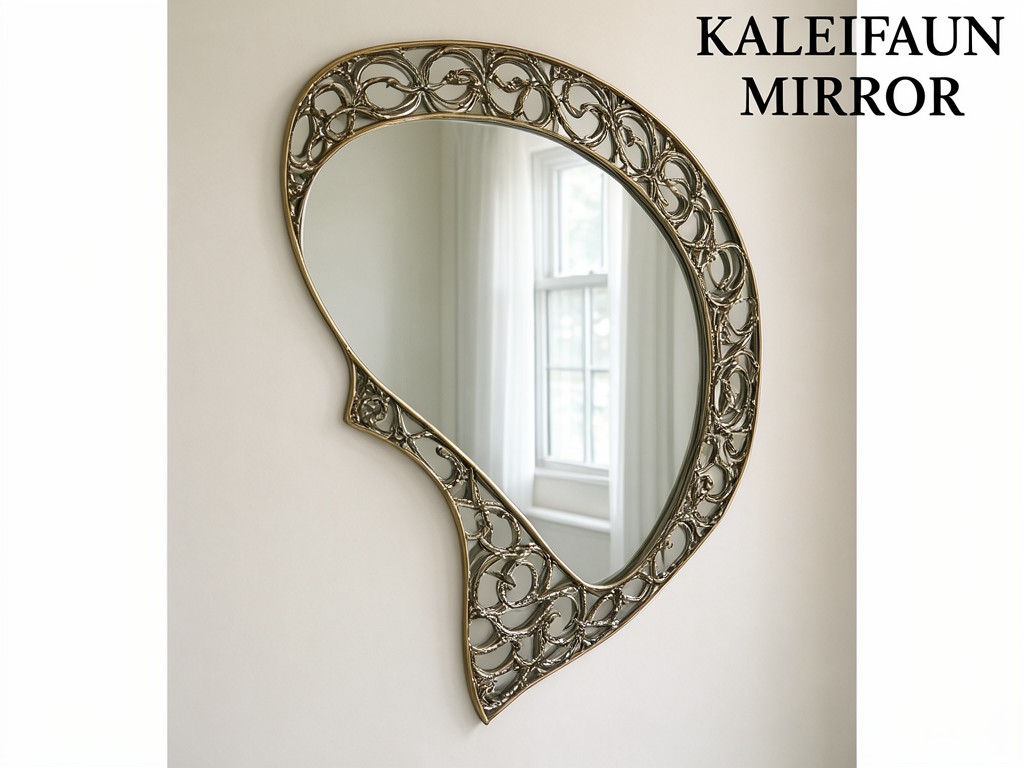
Drawing control: dimension the irregular outline from fixed datums and include the mounting locations. A silhouette image alone leaves room for interpretation during repeat production.
What Can Be Customised and What Cannot
Private-label programs can specify the mirror outline, glass thickness, polished or ground edge appearance, backing film, hanger arrangement, and retail packaging. Changes to the contour or mounting layout affect the cutting file and packaging fit, so each approved revision should carry a drawing version or sample reference.
Options That Scale Through the Process
The outline, glass thickness, edge finish, backing film, hanging hardware, and carton presentation can be specified for a program. Non-standard contours need a usable drawing and a confirmed radius where curves turn inward.
Limits Set by Glass and Freight
A flat mirror cannot reproduce a continuously bent reflective surface. Very tight concave turns, fragile projecting tips, and oversized panels can raise breakage risk or exceed practical cutting and carton limits; revise the geometry or divide the design if the selected process cannot support it.
A lower unit price may not be the lower landed cost if edge chips, inconsistent outlines, or unclear mounting instructions generate returns. Buyers should compare the glass and edge specification, packing method, and accepted appearance limits alongside piece price.
Quality Control and Batch Consistency
Fatigue appears at the stress concentration: a chip or sharp transition at an inward curve can become the starting point for a crack during handling or installation. Edge condition and contour geometry therefore deserve checks in addition to a face-side appearance review.
For OEM and private-label batches, retain the approved drawing, sample identification, and inspection record against each production lot. Check dimensions at consistent datum points, inspect polished edges and backing coverage, and confirm hanger placement before packing. Viewing conditions should be agreed for surface inspection; lighting angle and distance can change how minor surface marks appear.
- Record glass thickness and key outline dimensions against the approved specification.
- Inspect edges for chips, rough sections, and exposed backing or coating damage.
- Verify mounting locations and hardware orientation against the signed-off sample or drawing.
- Review any recurring transit damage by carton position before changing the product specification.
Export Packaging and Handling Protection
An irregular outline leaves projecting lobes and recessed curves more exposed to knocks than a rectangle. Separate each mirror from adjacent units, protect the finished edge, and prevent movement inside the carton; the exact insert and carton structure should match the panel size, weight, and shipping route.
Retail launch schedules are vulnerable to damage discovered after arrival, when replacements must travel through the same import process. Confirm carton orientation, handling marks, pack count, and retail labels before the production lot is packed. Ask for the proposed pack layout for review when the silhouette has narrow tips or deep concave sections.
Do not treat a backing safety film as a substitute for edge protection or a protective outer carton. It can help retain fragments if glass breaks, but it does not prevent impact damage.
Specification Review for Your Bulk Order
Send the outline drawing, target glass thickness, edge finish, backing and hanger requirements, retail-pack details, and destination market for a specification review. Clear references at quotation stage help align the approved sample, batch inspection, and export pack before your launch order moves forward.
Request a specification review for your custom asymmetrical curved decorative wall mirror program.







